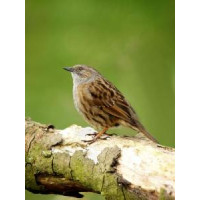
A most unusual little bird, that has several behavioural oddities.
It is a host of the Common Cuckoo. This is likely to be a recent association, since other Cuckoo hosts have learned to discriminate between eggs, and the Cuckoo has consequently evolved eggs that match those of its host. But In the case of the Dunnock, there is no resemblance, yet the Cuckoo eggs are accepted.
The Dunnock doesn't form pairs, females are often polyandrous, (breeding with two males at once) and, breed in groups of up to three males and three females, with two males and a female being the most common.
The males provide parental care in proportion to their mating success, so it is not uncommon to see two males and a female feeding chicks at one nest.
Polyandry is rare in birds, with only about 2% of species showing such a mating system; the majority are monogamous, where one male and one female breed together.
The Dunnocks' diet, consits of insects, in winter also seeds, mostly near ground in cover.
Length
14cm
Maximum Recorded Age
11 years, 3 months
Typical Lifespan
2 years
Age at First Breeding
1 year
Number of broods
2 or 3
Fledging
12-15 days
Number in Britain
2.1million
Conservation Status UK
Amber
Status in UK
Resident Breeder, passage/winter breeder
Incubation
14-15 days
Wingspan
20cm
Weight
21g
Habitat
Scrub, undergrowth, towns and villages
First Record
8th Century
Egg Size
19x15 mm
Egg Weight
2.1 g
Clutch Size
4-5 eggs
£17.86
£19.00
£20.24
£13.95
£20.50

£22.36
£13.20
£55.96 £93.16
£57.72 £63.50
£20.24

£22.36
£20.24
£20.24

£61.99 £90.43
£24.99
£9.99
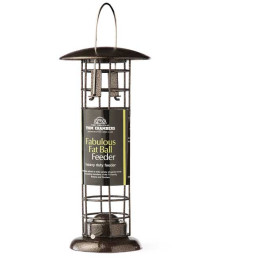
£12.95
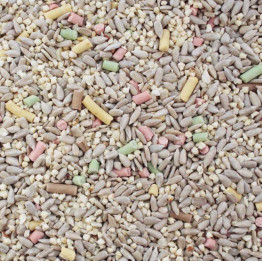
£17.84
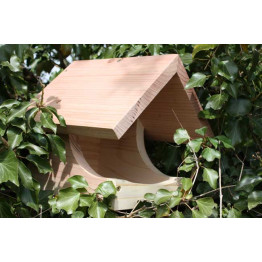
£29.95
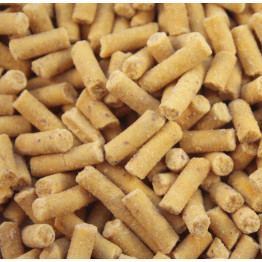
£22.36