
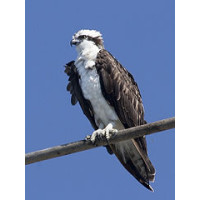
Seen in flight from below the osprey has white or slightly mottled underparts, and at a distance it could be mistaken for a large gull. This spectacular fish-eating bird of prey is an Amber list species because of its historical decline (due to illegal killing), and low breeding numbers.
Ospreys can fly up to 430km in one day on their migration to west Africa, they arrive back in late March and April, leaving again in August and September. The Osprey will nest in any location near a body of water providing an adequate food supply. It is found on all continents except Antarctica.
The Osprey's diet consists almost exclusively of fish, and in order to assist in hunting, it has developed some specialist attributes. Its toes are of equal length, and its talons are rounded, rather than grooved, and the Osprey is the only raptor whose outer toe is reversible, allowing it to grasp its prey with two toes in front and two behind. After catching the fish considerable effort is needed to get airborne again, and as it rises back into flight the bird turns the fish head-forward to reduce drag.
Egg Size
62x46 mm
Maximum Recorded Age
20 years, 11 months
Typical lifespan
8 years
Age at First Breeding
3 years
Number of broods
1
Fledging
53 days
Incubation
37 days
Clutch Size
2-3 eggs
Egg Weight
72g
Number in Britain
300 (Europe 12,000)
First Record
10th Century, then re-introduced in 1954, after being declared extinct in 916
Habitat
Thickets, damp undergrowth, and woodland
Weight
1.5Kg
Wingspan
158cm
Length
56cm
Status in UK
Migrant Breeder, Passage Visitor
Conservation Status UK
Amber