
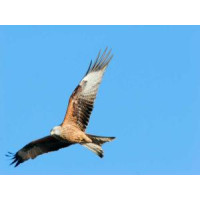
The Red Kite is a graceful bird of prey and is unmistakable with its reddish-brown body, angled wings and deeply forked tail. The red Kite was almost extinct and has now been successfully re-introduced to England and Scotland. Their diet is mainly from scavenging on carrion, scraps, and they will sometimes take small live prey.
The mother will, at signs of danger call the young who will "play dead" to the extent that a fox will believe them to be dead and leave them, thinking it can return to eat them later.
They nests in trees, and in winter, many kites will roost together. From a distance the nests look like rookeries, including the swirling pattern of the birds. You can see that the birds are not rooks but kites because of the more slender wings, and their forked tail.
Red Kites occupy their breeding home range all year. Each nesting territory can contain up to five alternative nest sites. The nest is built high in a fork or a limb of a tree. It is made of dead twigs and lined with grass and sheep’s wool.
We went to see them at Gigrin Farm, near Rhayader in Wales where between 200 and 400 kites visit per day www.gigrin.co.uk/ They are open every day, and the feeding birds come really close to you.
Number in Britain
900
Conservation Status UK
Amber
Status in UK
Resident/ Re-Introduced Breeder, Passage Visitor
Length
63 cm
Wingspan
185 cm
Weight
M.1Kg F.1.2Kg
Habitat
Pasture, open woodland, forest
First Record
8th Century
Egg Size
57x45 mm
Egg Weight
63 g
Clutch Size
2 eggs
Incubation
31-32 days
Fledging
50-60 days
Number of broods
1
Age at First Breeding
2 years
Maximum Recorded Age
20 years, 1 month