
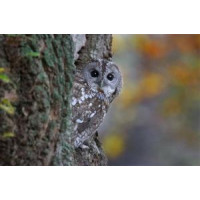
As with most owls, they are nocturnal and can regularly be heard but not seen. They can be spotted all year round and their diet consists of small animals such as frogs, Mice, Shrews, small birds and fish.
There are currently around 19,500 breeding pairs in England Scotland and Wales.
It is a common assumption that owls have very good sight in order to catch their prey during the dark hours but actually their retina is no more sensitive as the average human beings. It is their hearing that is exceptional, and their asymmetrically placed ears ensure they can hear everything at all times. This is key to hunting at night.
Young tawny owls stay with their parents until they are around three months old and it is then they are free to find their own territory. If they fail at this, they will starve.
Female Tawny owls are bigger than males and are usually 20-40% heavier with a larger wingspan
Tawny owls make their homes in holes in trees or buildings, however, specially built nest boxes can also be used. Common preditors of the tawny owl are other larger birds such as Eagle owls and Buzzards and the red fox is a threat to fledglings as they are finding their feet at an early age. Prey is normally swallowed whole, with the indigestible parts regurgitated as pellets. These are grey, and consist of mainly rodent fur, with protruding bones. The diet is made of, small mammals, birds, amphibians, worms and beetles, mostly between dusk and dawn.
Length
38 cm
Maximum Recorded Age
21 years. 5 months
Typical Lifespan
5 years
Age at First Breeding
1 year
First clutches laid
Late March
Number of broods
1
Number in Britain
40,000
Conservation Status UK
Green
Status in UK
Resident Breeder
Fledging
35-39 days
Wingspan
99cm
Weight
450g
Habitat
Forest, woodland, towns
First Record
8th Century
Egg Size
48x39 mm
Egg Weight
39 g
Clutch Size
2-3 eggs
Incubation
30 days