
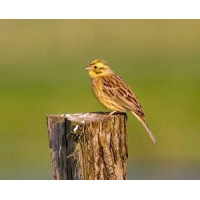
The beautiful Yellowhammer sings his song in the heat of the summer afternoon, a cheerful repetitive song he keeps up all day long. He will usually sing from an exposed perch, such as a fence post or wire, or a bush top or open branch.
The Yellowhammer is a bunting, rather than the finch that most think of him as, they have a long white edged tail, with a flat topped head, with a thinner top beak.
They frequent bushes, hedgerows and heath land, also, the Gorse and Bracken above cliffs. They appear on the red list due to the decline of these natural habitats.
Diet is mainly, grass seeds, cereal grain, and in the summer, invertebrates. Males are unmistakeable with a bright yellow head and underparts, brown back streaked with black, and chestnut rump.
Found across the UK but less so in the north and west. It nests in hedges, patches of scrub, and ditches, especially if these have a wide grass margin next to them, and a cereal crop next to the margin. Tall hedges are preferred, and they nest after it is in full leaf.
Age at First Breeding
1 year
First clutches laid
Early May
Fledging
13-16 days
Number of broods
2 or 3
Incubation
13-55 days
Clutch Size
3-4 eggs
Egg Size
22x16 mm
Typical Lifespan
3 years
Maximum Recorded Age
11 years, 9 months
Egg Weight
2.9 g
Number in Britain
1,700
Conservation Status UK
Red
Length
16 cm
Status in UK
Resident Breeder, Passage/Winter Visitor
Wingspan
26 cm
Weight
31g
Habitat
Grassland, farmland, coastal cliffs
First Record
8th Century
£16.99
£55.96 £93.16

£61.99 £90.43
£9.99