
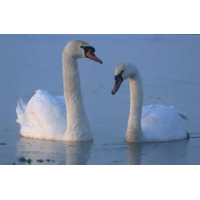
Mute Swans are the largest members of the duck family, and are amongst the largest flying birds in the UK, weighing up to 15 kg. The sexes are alike in plumage, but males are generally bigger and heavier than females.
Swans feed in the water as well as land. They are almost entirely herbivorous, although small numbers of aquatic animals may be eaten. In the water food is obtained by up-ending or dabbling, and their diet is composed of the roots, tubers, stems and leaves of aquatic and submerged plants.
Swans form monogamous relationships that last for many years. Most people belive these bonds last for life, but divorces between pairs do occur. Unlike many other ducks and geese the male helps with the nest construction, and will also help to incubate the eggs.
The mute swan is a very large white waterbird. It has a long S-shaped neck, and an orange bill with black at the base of it. The population in the UK has increased recently, perhaps due to better protection of this species. There is less of a problem with lead poisoning now, since the ban on selling lead fishing weights. Some birds stay in their territories all year, while others move short distances and form winter flocks.
Swans eat aquatic vegetation, which their long necks equip them to take from the riverbed. They take the molluscs that cling to the vegetation, and also eat small fish, frogs and worms.They will graze on grassy fields, and can survive quite successfully in a field of short-cropped grass.
Swans normally find enough food in the wild without supplementary feeding. It is only in freezing weather that extra food can be helpful. It is ok to feed bread to Swans, and unlikely to cause any long term harm, but there is no substitute for a diet that is sought after in the wild. Grain, such as wheat, and vegetable matter, especially lettuce and potatoes, can be fed to swans.
In England, swans are marked annually and this is called Swan-Upping for the Queen.
Wingspan
223 cm
Maximum Recorded Age
26 years, 9 months
Typical Lifespan
10 years
Age at First Breeding
4 years
First clutches laid
Late March
Number in Britain
12000
Conservation Status UK
Amber
Status in UK
Resident Breeder
Length
152 cm
Number of broods
1
Weight
M11Kg F9Kg
Habitat
Lakes ponds and rivers
First Record
8th Century
Egg Size
113x74 mm
Egg Weight
340 g
Clutch Size
4-7 eggs
Incubation
34-45 days
Fledging
35-41 days